Powder coating has revolutionized the way manufacturers and fabricators protect and beautify metal surfaces. Unlike traditional liquid paint, this dry finishing process delivers superior durability, environmental benefits, and cost-effectiveness, making it the preferred choice across industries, from automotive components to outdoor furniture.
If you're considering powder coating for your manufacturing operation or simply want to understand why it's become the industry standard, this comprehensive guide will walk you through everything you need to know.
What is Powder Coating?
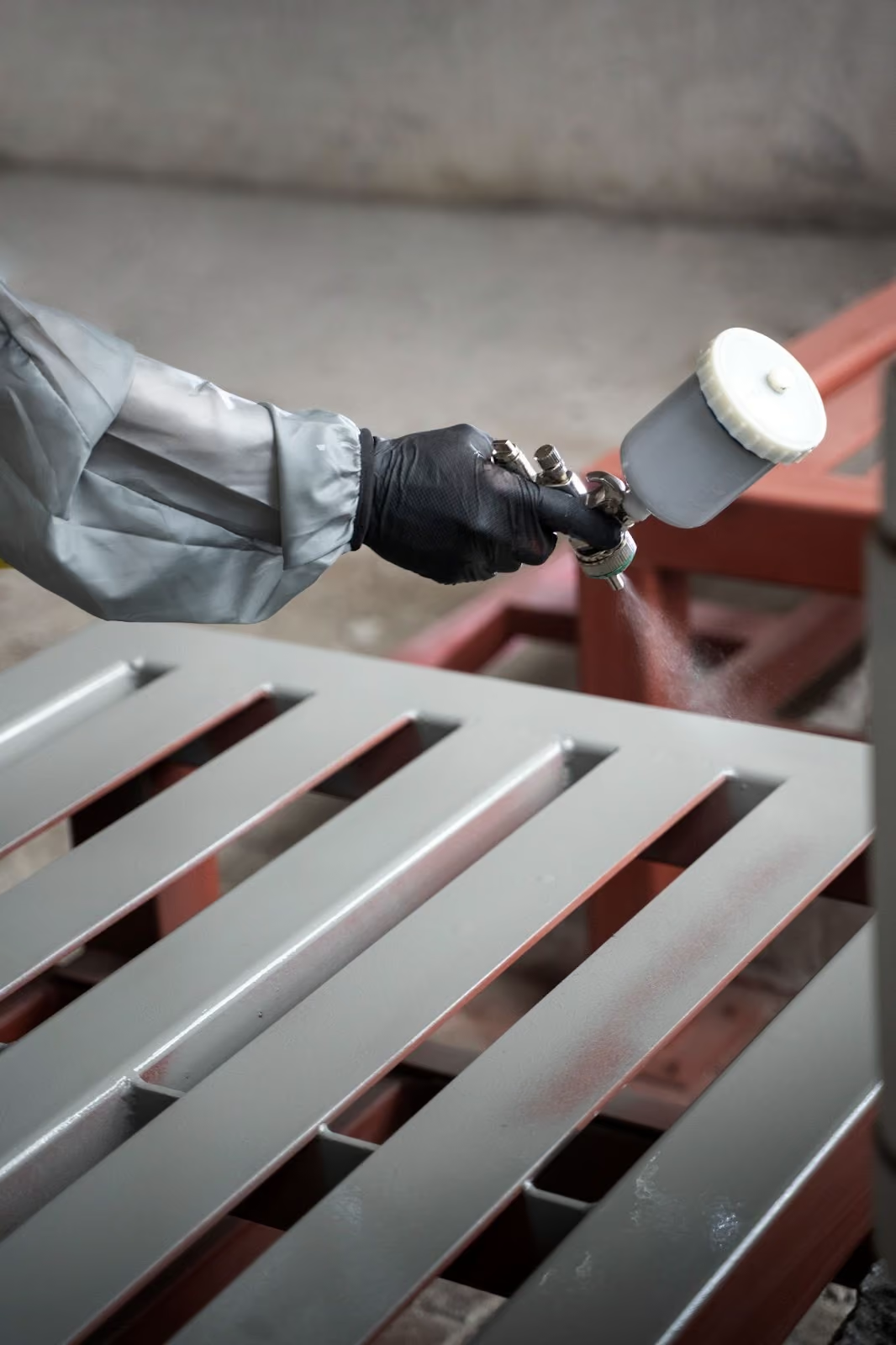
Powder coating is a dry finishing process that applies a free-flowing, thermoplastic or thermoset polymer powder to a surface. The powder is electrostatically charged and sprayed onto grounded metal parts, where it adheres through electrostatic attraction. The coated parts then enter a curing oven, where heat melts and flows the powder, chemically bonding it to the surface, creating a uniform, durable finish.
Think of it this way: instead of brushing or spraying wet paint that needs to dry through solvent evaporation, you're applying a fine powder that transforms into a solid protective layer through heat.
How Is Powder Coating Different from Liquid Paint?
Traditional paint is a mixture of pigments and resins suspended in a liquid solvent. When you apply it, you're waiting for that solvent to evaporate, leaving behind the solid coating. This evaporation releases volatile organic compounds (VOCs) into the atmosphere and represents material you paid for that literally disappears into thin air.
Powder coating flips this entirely. The coating material is manufactured as a solid powder from the start. Finely ground particles of pigment and resin are mixed together. This powder has no solvent, no liquid carrier, nothing that needs to evaporate. It exists as a stable, dry powder until you're ready to use it.
This powder is then given an electrostatic charge as it leaves the spray gun, typically negative. The metal part is grounded, giving it a positive charge. Those oppositely charged particles fly through the air and stick to the metal surface through pure electrostatic attraction, similar to the effect of rubbing a balloon on your hair and sticking it to a wall.
Once that powder is on the part, you move it into a curing oven. At temperatures typically between 350 and 400 degrees Fahrenheit, the powder undergoes a complete transformation. The particles melt, flow together, and if you're using thermoset powder, they chemically cross-link into a continuous film.
This results in a uniform finish that's essentially one continuous molecule wrapped around your part.
The Complete Process of Powder Coating
Each step in the powder coating process directly impacts whether this finishing method will work for your application. Here’s how the process flow looks
- Surface preparation removes all contamination: Metal parts carry mill scale, rust, welding residue, cutting fluids, and handling oils that must be completely eliminated. Parts move through multi-stage wash systems with heated alkaline cleaners, clean water rinses, and conversion coating application.
- Conversion coating creates the foundation: Iron phosphate for steel or zirconium-based treatments for aluminum create a crystalline surface layer that provides mechanical tooth for adhesion and adds corrosion protection between base metal and topcoat. The highest quality powder fails on improperly prepared surfaces.
- Electrostatic application happens in the coating booth: Dried parts enter on conveyors where spray guns charge powder particles through corona discharge or friction. Charged particles are actively attracted to grounded metal, wrapping around edges and into recesses the gun isn't pointed at.
- Overspray gets reclaimed, not wasted: Powder that misses the part falls to the booth floor, where recovery systems collect it, sieve out contamination, and return it to the coating system.
- Heat curing transforms powder into a permanent finish: Coated parts enter ovens at 350-400°F, where powder particles melt and flow into a continuous film, then thermoset formulations cross-link into a three-dimensional molecular network through chemical reaction.
- Cure precision determines final properties: Undercure produces soft finishes with poor chemical resistance. Overcure causes color shift, gloss loss, or brittleness. Typical cure schedules run 10-20 minutes at peak metal temperature, creating mechanical and chemical properties that liquid paints cannot match.
When Should You Avoid Powder Coating: 6 Scenarios to Consider

Understanding what powder coating means, and honestly acknowledging its limitations. Here are the situations where powder coating creates more problems than it solves, along with clear alternatives.
1. Heat-Sensitive Products and Assemblies
Standard powder coating requires exposing parts to 350-400°F for 10-20 minutes during curing. This single requirement eliminates entire categories of products from consideration. Any substrate or component that cannot tolerate this temperature cannot be powder-coated using conventional processes.
Most plastics and composites fall into this category immediately. Electronic components, rubber seals, adhesives, and pre-assembled items with heat-sensitive parts all fail at these temperatures.
The problem runs deeper than many OEMs initially realize: heat conducts through metal structures, so masking sensitive components doesn't solve the issue. The entire assembly reaches cure temperature, which means the protected parts could still experience thermal damage.
The alternative:
Redesign your assembly sequence to powder coat metal components before adding heat-sensitive parts. This single change solves the problem in most cases and often improves your manufacturing process by separating finishing from final assembly.
If redesign isn't possible, liquid paint systems that cure at ambient temperature or low-bake temperatures (150-180°F) become your only viable option. Accept that you're choosing liquid coating not because it's better, but because your product design requires it.
2. Tight Dimensional Tolerances
Powder coating has physical limitations on minimum film thickness that create problems for precision applications. The particle size and flow characteristics of powder mean you typically cannot achieve uniform films thinner than 1.5 to 2 mils (40-50 microns).
Most powder coating applications run 2-4 mils for optimal performance and appearance. This thickness adds up quickly on parts with critical dimensions.
Precision-machined parts where coating buildup on critical dimensions affects fit and function face similar issues. Threaded components present particular challenges, like coating thickness in threads preventing proper engagement or requiring post-coating thread chasing, adding operations and cost.
Masking can protect some critical dimensions, but it adds cost and complexity while creating aesthetic issues at the interface between masked and coated areas. It doesn't solve the problem for features that need both coating protection and precise dimensions. You're left choosing between protection and function, which isn't really a choice at all for most applications.
The alternative:
Liquid paint systems can achieve very thin, uniform films when necessary, giving you coating protection without dimensional interference. For applications where every tenth of a mil matters to fit and function, liquid coating provides the control you need.
You can also consider anodizing. Rather than adding a coating layer on top of the metal, anodizing is an electrochemical process that converts the aluminum surface itself into a hard, corrosion-resistant oxide layer. This preserves fine details and dimensional accuracy while providing excellent wear resistance and the option for dyed colors.
3. Field Repair and Touch-Up Requirements
One of powder coating's most significant limitations for OEMs is that it cannot be easily touched up or repaired in the field. Applying and curing powder coating requires controlled conditions: an electrostatic application system and a curing oven operating at precise temperatures. These cannot be replicated at a customer's installation site or during field service.
If your product will inevitably incur installation damage, or if field service involves operations that could damage the finish, powder coating creates customer service headaches that ripple through your organization.
Construction equipment gets scratched during delivery and installation. Architectural products require field modifications where installers drill additional mounting holes or make cuts to fit site conditions. Industrial equipment maintenance procedures require removing guards or panels that get dinged in the process. All of this damage becomes a finishing problem when you've chosen powder coating.
The alternative:
Stock replacement components that customers can swap instead of attempting repairs. This works if the damaged component is modular and easily replaceable, though it increases your inventory costs and requires customers to perform component replacement.
Some OEMs simply accept that field damage means imperfect repairs and educate customers accordingly during sales. But if field repairability is critical to your customers' experience, liquid paint's touchability outweighs powder coating's other advantages.
Choose the finish that matches how your product is used, not just the one that performs best in laboratory testing.
4. Oversized Components Beyond Standard Oven Capacity
Parts must physically fit in your curing oven for powder coating to work. While industrial ovens can be built to enormous sizes, there are practical and economic limits that make powder coating impractical for truly large products.
Standard industrial batch ovens typically measure around 8 feet wide by 10 feet high by 20 feet deep, accommodating the vast majority of manufactured products. Industrial batch ovens commonly range from 4'x6'x10' for smaller operations to 10'x12'x30' or larger for high-volume manufacturers. But architectural components, large industrial frames, construction equipment, and similar oversized products often exceed these dimensions.
The alternative:
Electrocoating is one of the better ways to handle coating oversized components.
You can submerge the parts in a tank of water-based paint, and the electrical current deposits the coating uniformly across all surfaces, including complex internal geometries. While e-coating still requires oven curing, the immersion tanks can often accommodate larger or more complex assemblies than powder coating booths.
E-coating provides exceptional corrosion protection and is the standard primer for automotive bodies and frames.
5. Non-Conductive Substrates
The electrostatic application that makes powder coating so effective requires that your part be electrically conductive and grounded. Powder coating is primarily a process for metal substrates, steel, aluminum, stainless steel, and other conductive materials. The charged powder particles must be attracted to a grounded surface, which is the fundamental principle that makes the process work.
Non-conductive materials like plastics, composites, wood, and glass cannot be conventionally powder-coated because they cannot be grounded to attract the charged powder particles. The powder simply won't adhere during application, making the process impossible without extensive modifications. Special techniques exist to coat some non-metallic substrates, but they add significant complexity and cost that often makes them impractical for production use.
Some plastics can be made conductive through additives or surface treatments, then powder-coated using modified processes and low-temperature cure cycles. But this requires specialty powders, precise process control, works only with specific plastics, and still doesn't deliver the same results as powder coating metal. The process becomes expensive enough that liquid paint systems designed for plastics usually make more economic sense.
The alternative:
If your substrate isn't metal, liquid paint systems designed for plastics and composites are simpler, more reliable, and usually more cost-effective than attempting specialty powder coating processes.
When non-stick properties, chemical inertness, or extreme temperature resistance matter more than mechanical durability, fluoropolymer coatings provide capabilities that powder coating cannot match. These are essential for chemical processing equipment, food processing machinery, and applications involving continuous temperatures above 400°F.
If product performance allows it, switching to metal construction opens up powder coating as an option. But forcing powder coating onto non-metallic substrates typically costs more than conventional liquid coating while delivering inferior results.
6. Deep Recesses and Complex Internal Geometries
While powder coating's electrostatic wrap provides excellent coverage on most geometries, it has real limitations with very deep recesses, narrow openings, and complex internal passages.
The Faraday cage effect occurs when the electrostatic field is blocked or shielded, preventing charged powder particles from reaching certain areas. This isn't a technique problem you can solve with better operators.
Deep box sections with small openings, long tubes with small diameters, and areas where metal surfaces surround an opening on multiple sides all experience Faraday cage effects to varying degrees. Powder may not reach the deepest portions of these recesses, or coverage may be thin and non-uniform. If these hidden areas require corrosion protection or appearance coating, inadequate coverage creates quality problems that surface after installation.
The alternative:
Redesign to eliminate deep recesses or increase opening sizes if coating these areas is critical. Internal powder guns exist for tube interiors, but add high cost and complexity.
Liquid paint applied by spray, flow coating, or dipping reaches complex internal geometries more effectively than electrostatically applied powder.
Before committing to powder coating for production, build prototypes and test the coating process. Cut coated parts open to verify powder reached all critical areas. If internal surfaces show bare metal or thin coverage, either modify the geometry or choose a coating method that penetrates complex structures, where accepting inadequate coating in critical areas is not an option.
Partner With Wootz for Expert Metal Fabrication and Finishing
We combine precision metal fabrication with advanced finishing capabilities to deliver components that meet your exact specifications. Our engineering team works with you during the design phase to ensure your products are optimized for the most appropriate finishing method.
Ready to discuss your next project?
Contact Our Engineering Team Today [CTA]
FAQ
Making the Right Choice for Your Application
Understanding what powder coating is is just the beginning. At Wootz, we combine precision metal fabrication with advanced powder coating capabilities to deliver finished components that meet the highest quality standards.
Our facility features state-of-the-art pretreatment systems, automated powder coating lines with precisely controlled curing, and liquid paint capabilities for applications where powder coating isn't the optimal choice.

.svg)