A decade ago, sustainable manufacturing was mostly associated with corporate pledges and emissions targets. Today, it is showing up in much more practical places: factory floors, packaging lines, procurement systems, warehouse operations, and industrial energy infrastructure.
Manufacturers across sectors are investing in smarter production systems, not just because of environmental pressure, but because inefficient operations are becoming expensive to maintain. Sustainable manufacturing is increasingly turning into an operational strategy rather than a branding exercise.
Why Manufacturing Processes Need to Be Sustainable
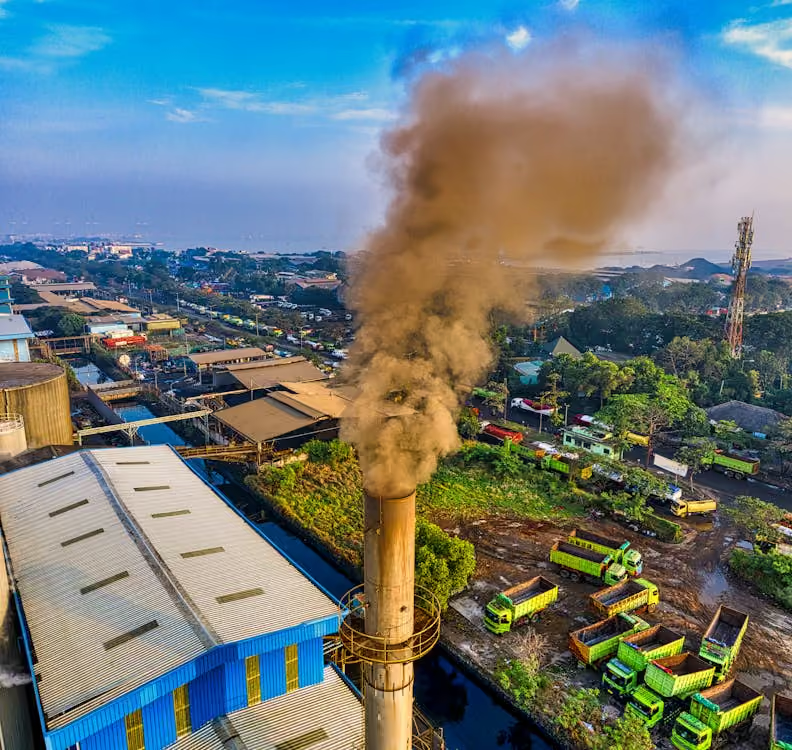
Heavy industries such as cement alone contribute roughly 7–8% of global greenhouse gas emissions. Semiconductor manufacturing facilities are also consuming increasingly large quantities of electricity and water as demand for AI infrastructure grows worldwide.
At the same time, climate-related operational risks are becoming more visible. Water shortages are beginning to affect industrial planning in sectors like semiconductor manufacturing, where facilities depend on reliable access to ultrapure water. Reuters reported that the average semiconductor factory now uses as much water as 33,000 U.S. homes in its report on industrial water consumption and chip manufacturing.
This is why sustainable manufacturing is increasingly being treated less as a branding initiative and more as a resilience strategy. Factories are not changing simply to appear greener. They are changing because inefficient operations are becoming expensive, risky, and harder to justify in modern supply chains.
Regulations are also accelerating the shift toward sustainable manufacturing. The European Union’s Carbon Border Adjustment Mechanism (CBAM), for example, is increasing pressure on exporters in industries such as steel, aluminum, cement, fertilizers, and hydrogen to measure and report embedded carbon emissions more accurately.
As carbon reporting requirements become stricter across global supply chains, manufacturers are being pushed to improve traceability, energy efficiency, and emissions visibility across production operations.
Why Sustainable Manufacturing Has Become a Competitive Requirement
For years, sustainability in manufacturing was treated as a reporting exercise. Factories focused on production speed and output, while environmental goals largely stayed inside annual ESG documents. That separation is starting to disappear.
Today, sustainable manufacturing is becoming part of day-to-day industrial operations. Manufacturers are redesigning production systems to reduce energy waste, improve material efficiency, recycle water, shorten supply chains, and build factories that are both more resilient and more cost-efficient.
Rising Energy and Resource Costs Are Reshaping Manufacturing Priorities
Manufacturing has always depended heavily on energy, raw materials, transportation, and water. But for the past decade, these inputs were relatively predictable. Factories optimized around throughput, labor efficiency, and production speed because energy prices were stable enough and environmental compliance requirements remained manageable.
That operating environment has changed significantly. Electricity demand is increasing globally as industries digitize and electrify operations. Companies like Schneider Electric are seeing rapidly growing demand for smart energy management systems because industries and data centers are trying to manage rising power consumption more efficiently.
Enterprise Buyers Are Prioritizing Sustainable Manufacturing Suppliers
Manufacturers are also facing pressure from large buyers that increasingly expect sustainability reporting across supply chains. Enterprise procurement teams now ask suppliers for emissions data, renewable energy commitments, packaging details, and operational transparency.
Consumers are influencing industrial decision-making as well. Food brands are redesigning packaging systems because plastic waste regulations are tightening. Electronics companies are being scrutinized for water consumption and supply-chain emissions. Automotive manufacturers are facing pressure to reduce lifecycle emissions across production and logistics networks.
Manufacturers Meeting Sustainability Regulations Are Winning More Global Contracts
Sustainability regulations are no longer affecting only environmental reporting teams. They are increasingly influencing which manufacturers qualify for international supply chains, long-term procurement contracts, and export opportunities.
The European Union’s Carbon Border Adjustment Mechanism (CBAM), for example, is pushing exporters in industries such as steel, aluminum, cement, fertilizers, and hydrogen to measure and report embedded carbon emissions more accurately.
At the same time, regulations like the EU’s CSRD, Extended Producer Responsibility (EPR) laws, and growing ESG disclosure requirements in the U.S. and Asia are increasing expectations around traceability, packaging sustainability, emissions visibility, and energy efficiency.
As a result, manufacturers that invest in sustainable manufacturing systems are often becoming more attractive to global buyers looking for lower-risk, regulation-ready suppliers. Companies with stronger emissions tracking, recyclable packaging systems, digital traceability, and energy-efficient operations are increasingly better positioned to expand trade relationships, enter regulated export markets, and secure larger enterprise contracts.
Climate Risks Are Forcing Manufacturers To Build More Resilient Operations
Operational risks linked to climate change are also becoming harder for manufacturers to ignore. Water stress is beginning to affect industrial planning globally, especially in regions with expanding semiconductor and data center infrastructure.
This combination of economic pressure, regulation, buyer expectations, and resource constraints is forcing manufacturers to redesign operational systems that remained largely unchanged for decades. The result is a broader shift toward factories that are more efficient, more measurable, and less wasteful overall.
7 Ways Manufacturers Are Building More Sustainable Factories
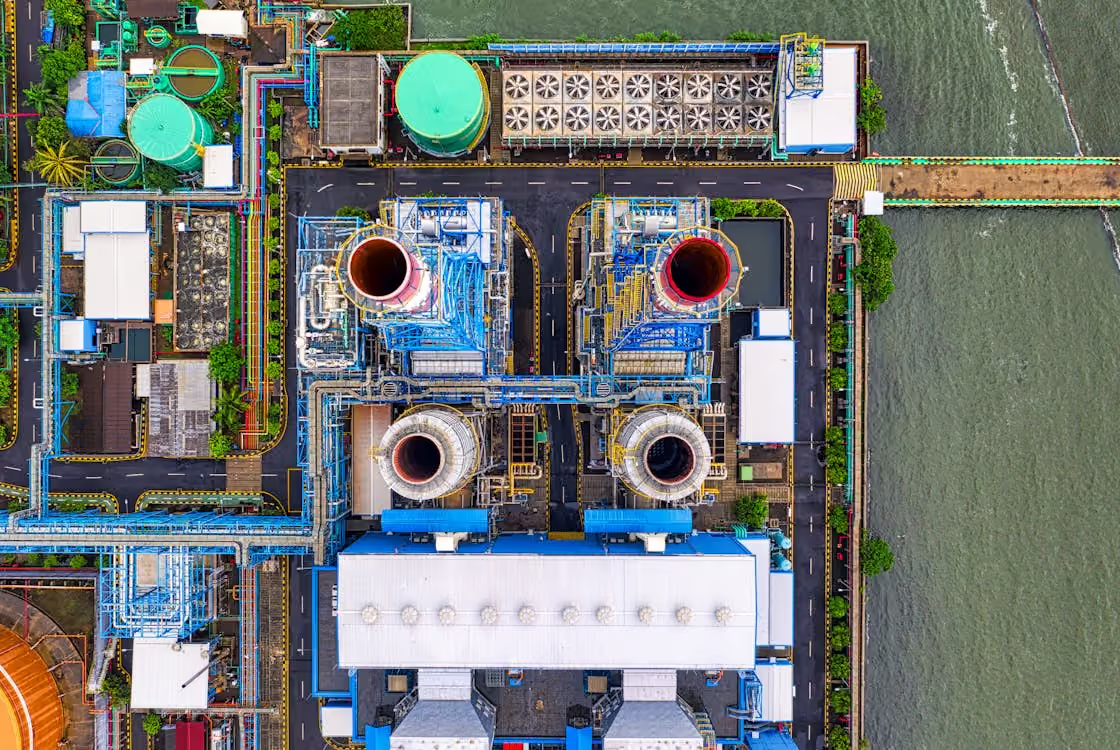
For decades, industrial sustainability was treated as a parallel conversation to manufacturing itself. Companies discussed emissions targets in annual reports while factories continued operating much the same way they always had.
Production output remained the priority. Energy inefficiencies were tolerated as a cost of doing business. Waste was often viewed as unavoidable. Environmental initiatives existed, but they rarely reshaped the core systems running industrial operations.
That separation is disappearing.
Today, sustainability is moving directly into the operational center of manufacturing. Plant managers, procurement leaders, engineers, and supply-chain teams are increasingly being asked to solve problems that are both environmental and financial at the same time. Rising electricity prices, stricter regulations, volatile raw material costs, water shortages, export requirements, and customer pressure are all pushing manufacturers to rethink how factories consume resources. Here are a few ways plants are practicing sustainable manufacturing:
1. Manufacturers Are Using AI to Reduce Energy Waste
In many industrial facilities, energy waste happens quietly.
Compressed air systems leak for months without detection. Idle machines continue consuming power between production runs. Heating and cooling systems operate at full capacity regardless of production schedules. Large facilities often run dozens of energy-intensive systems simultaneously, making inefficiencies difficult to identify manually.
This is why manufacturers are increasingly using AI-driven monitoring systems and predictive analytics to optimize factory energy consumption in real time.
The cement industry offers one of the clearest examples of this transition. Cement production remains one of the world’s most emissions-intensive industrial processes because of the massive heat required to produce clinker, the core ingredient in cement. So some cement manufacturers are using AI systems to optimize kiln operations, fuel usage, and production stability in order to reduce emissions and improve efficiency.
Climate-tech company Carbon Re estimated that AI optimization systems could reduce fuel-related emissions at cement plants by as much as 20%. Chemical manufacturers are also using AI to reduce waste and improve production performance. For instance, Covestro implemented AI systems at chemical plants to improve efficiency and reduce operational waste.
2. Factories Are Recovering Heat Instead of Letting It Escape
Industrial manufacturing produces enormous amounts of wasted heat. Historically, much of that thermal energy simply escaped through exhaust systems, cooling operations, furnaces, and industrial processes without being reused. In sectors such as steel, cement, glass, chemicals, and aluminum production, heat loss has long been treated as unavoidable.
Now, manufacturers are increasingly viewing waste heat as a recoverable energy source.
Waste heat recovery systems capture excess thermal energy from industrial processes and redirect it into other operations such as power generation, facility heating, steam production, or secondary manufacturing processes. In energy-intensive industries, even small improvements in thermal efficiency can significantly reduce fuel consumption and emissions over time. This is becoming especially important in sectors facing intense decarbonization pressure.
3. Manufacturers Are Redesigning Production to Reduce Material Waste
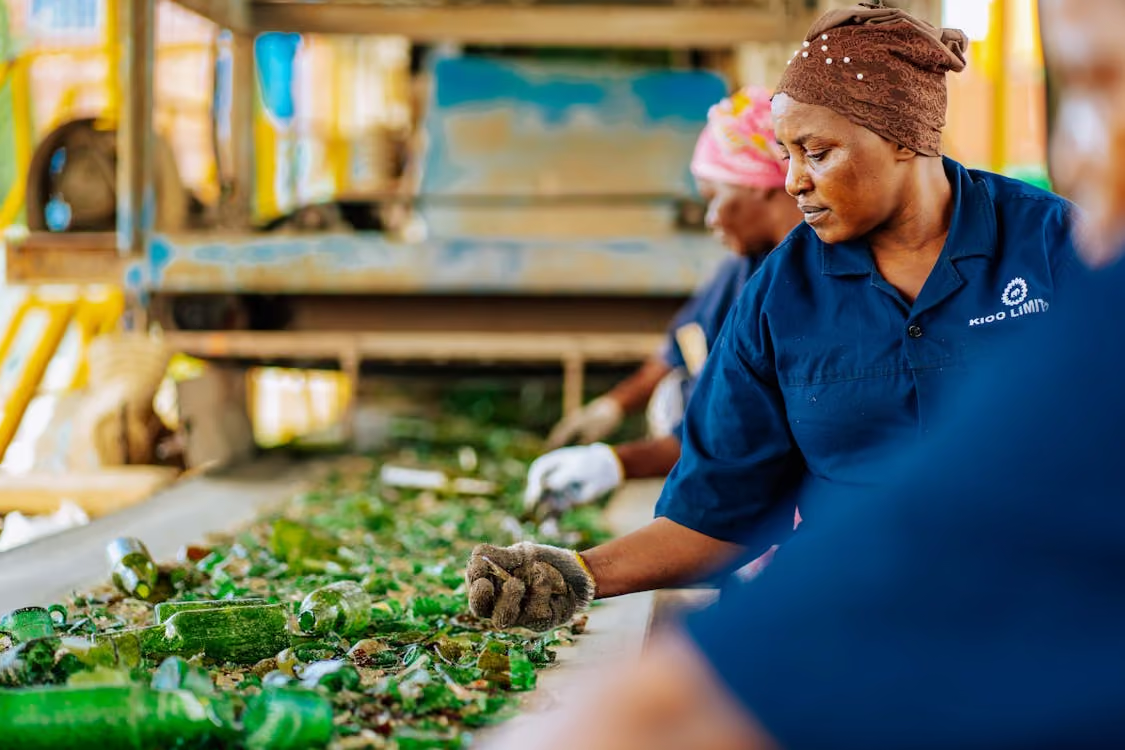
Waste reduction in manufacturing is no longer just about recycling scrap after production. Increasingly, manufacturers are redesigning production systems to prevent waste before it happens.
Digital manufacturing tools are playing a major role here:
- Advanced simulation software allows manufacturers to test production designs virtually before manufacturing begins.
- Automated quality-control systems help identify defects earlier in production runs before large batches become unusable.
- Precision cutting systems improve material utilization and reduce scrap generation.
Also, lean manufacturing principles are increasingly overlapping with sustainability goals. Factories reducing overproduction, minimizing defects, improving yield rates, and optimizing material usage are often lowering environmental impact at the same time.
Packaging redesign is also becoming part of this effort. Manufacturers are increasingly reducing unnecessary packaging weight, replacing difficult-to-recycle materials, and shifting toward recyclable or molded fibre alternatives to reduce both waste and transportation costs.
4. Renewable Energy Is Moving Inside Industrial Operations
Renewable energy adoption inside manufacturing used to be treated primarily as a public sustainability commitment. Increasingly, it is becoming an operational cost strategy.
Factories consume massive amounts of electricity every day through machinery, HVAC systems, robotics, cooling systems, lighting, and automation infrastructure. As electricity prices fluctuate globally, manufacturers are looking for ways to stabilize long-term energy costs while reducing emissions exposure.
This is accelerating investments in rooftop solar systems, renewable power purchasing agreements, battery storage systems, and industrial microgrids. Schneider Electric’s energy management expansion is an example of how industries are rapidly increasing investments in smart energy systems and electrification technologies.
5. Water Recycling Is Becoming Critical for Industrial Manufacturing
Water management is emerging as one of the most important industrial sustainability challenges globally. Many manufacturing sectors depend heavily on water-intensive operations, including semiconductor fabrication, food processing, chemicals, mining, and energy production. As drought risks and water shortages become more severe in several industrial regions, manufacturers are being forced to rethink water consumption patterns.
Modern chip fabrication requires enormous quantities of ultrapure water for cleaning and processing wafers. For instance, the average semiconductor factory consumes as much water as 33,000 U.S. homes.
This has pushed major chip manufacturers toward aggressive water recycling initiatives, like the Taiwan Semiconductor Manufacturing Company’s Arizona facilities, which aim to achieve a 90% water recycling rate while developing advanced reclamation systems. And Intel has also invested heavily in water recovery and restoration efforts to return billions of gallons of water back into municipal systems and restoration projects.
6. Supply Chains Are Becoming Shorter and More Regional
For years, manufacturing supply chains prioritized cost efficiency above almost everything else. Production moved farther offshore, supplier networks became increasingly fragmented, and transportation systems stretched across continents.
The pandemic exposed how fragile many of those systems had become. Now, manufacturers are rethinking supply-chain structure through both a sustainability and resilience lens.
Long-distance logistics networks increase transportation emissions, extend lead times, and create greater exposure to geopolitical disruptions, fuel volatility, and regulatory changes. As a result, some companies are shifting toward regional sourcing, distributed manufacturing models, and supplier diversification strategies.
Shorter supply chains often reduce transportation emissions while also improving responsiveness and operational stability. Manufacturers are also investing more heavily in supply-chain visibility tools that track sourcing practices, logistics performance, and supplier sustainability metrics.
7. Sustainable Packaging Is Reshaping Manufacturing Decisions
Packaging has become one of the most visible sustainability issues across global manufacturing.
Governments are tightening regulations around plastic waste. Consumers are questioning excessive packaging. Food brands are being pushed toward recyclable and compostable alternatives. Logistics companies are trying to reduce shipping weight and waste simultaneously.
As a result, packaging decisions are increasingly affecting manufacturing strategy itself. Manufacturers are redesigning packaging systems around material reduction, recyclability, lightweight structures, and transportation efficiency. Molded fibre packaging, recyclable mono-material systems, compostable food packaging, and PFAS-free materials are becoming more common across consumer and industrial sectors.
This shift is already visible in high-mix food manufacturing environments. Wootz.work, for example, designed an automated meal preparation and packaging system for a UK food brand that scaled production from 250,000 to 1 million meals per month while replacing plastic containers with molded-fiber packaging and introducing real-time production traceability across thousands of SKU combinations.
This shift is not happening purely because of environmental pressure. Packaging inefficiencies directly affect freight costs, storage requirements, disposal expenses, and material procurement spending.
Other Quicker Sustainability Changes Manufacturers You Can Make
- Employee-Led Tree Planting and Restoration Programs: Some manufacturers are moving beyond one-time CSR campaigns and investing in long-term ecological restoration projects tied to broader sustainability goals. H&M linked biodiversity restoration and nature-focused initiatives with emissions and supply-chain sustainability efforts.
- Replacing Single-Use Plastics Inside Facilities: Factories are increasingly reducing internal plastic waste through reusable containers, refill stations, recyclable cafeteria packaging, and reusable warehouse materials.
- Electrifying Internal Factory Transport: Many industrial facilities are replacing diesel-powered forklifts, warehouse carts, and internal transport vehicles with electric alternatives to reduce fuel consumption and indoor emissions. Companies across industries are pairing EV adoption with renewable energy and wastewater recycling goals.
- Switching to Recyclable Packaging Materials: Packaging changes are becoming one of the fastest sustainability upgrades manufacturers can implement. NVIDIA reported that 97% of its packaging had become recyclable as part of broader sustainability efforts tied to renewable energy adoption and emissions reductions.
- Greener Factory Buildings and Campuses: Newer industrial facilities are increasingly being designed around energy-efficient infrastructure, including rooftop solar systems, rainwater harvesting, natural lighting, smart HVAC systems, and shaded green spaces. Schneider Electric continues expanding smart energy and electrification technologies focused on improving industrial energy efficiency
Sustainability Is Becoming a Manufacturing Discipline
The factories making the biggest sustainability gains are rarely the ones making the loudest environmental claims.
More often, they are the manufacturers quietly redesigning systems that were once considered too expensive, too complicated, or too deeply embedded to change. They are reducing energy waste because electricity costs are rising. They are recycling water because supply risks are growing. They are redesigning packaging because regulations and logistics costs are changing. They are regionalizing supply chains because resilience matters more than it did a decade ago.
What is happening inside manufacturing today is less about image and more about operational adaptation.
The shift is still unfolding, yet many industries remain far from fully sustainable. Heavy manufacturing continues to face enormous decarbonization challenges. Resource-intensive sectors will require major technological advances over the coming decades.
But the direction is increasingly clear. Sustainability is no longer sitting outside the factory. It is moving into the systems that run it every day.

.svg)