Choosing an industrial valve is about matching the valve's behavior to the process's behavior. Every plant sees pressure swings, temperature changes, variable flow conditions, and different degrees of contamination, and valves respond to these shifts in very different ways.
The right choice of an industrial valve keeps the system stable without constant adjustment, and helps prevent small inefficiencies that accumulate into downtime, wear, or unreliable flow control. A practical selection process looks beyond the valve’s basic functions and focuses on how it performs across the entire operating cycle of the line.
What Are Industrial Valves?
Industrial valves are mechanical devices that regulate, stop, redirect, or control the flow of liquids, gases, steam, or slurries in a process line. They are used to maintain equipment, protect upstream components, manage transitions between operating states, and keep systems stable when conditions shift.
In manufacturing environments, valves help control and maintain the intended flow, which is crucial for process repeatability and determines the system's ability to handle surges.
Some industrial valves are built for clean isolation, some for precise modulation, and others for protection against conditions like reverse flow or overpressure. Understanding how each type operates helps match valve behavior to process behavior.
What Are the Different Types of Industrial Valves Used in Manufacturing Systems?
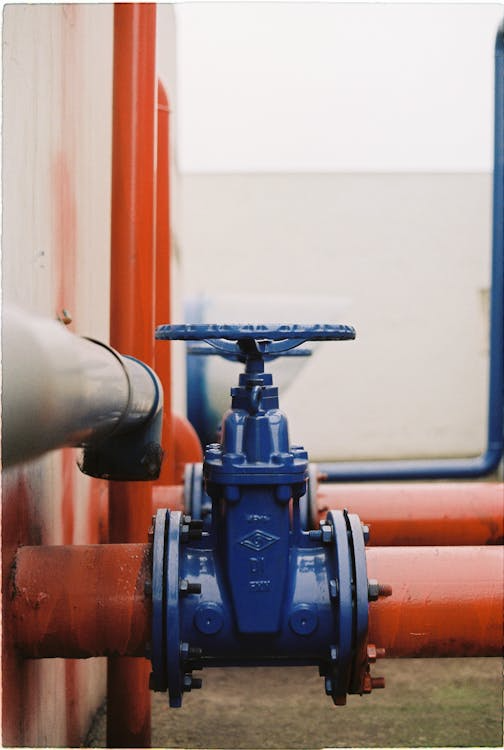
There are different types of industrial valves used in manufacturing systems, each unique based on its applications and placement.
Industrial ball valves behave well in isolation duties where clean shutoff matters more than modulation.
Their simple rotation and minimal flow obstruction make them predictable even for occasional system operations. There are three types of ball valves:
Three-piece bodies become valuable when internal components need periodic replacement, while unibody construction fits compact lines where maintenance access is less frequent.
Industrial gate valves are used where flow needs to move through with minimal restriction. They are not meant to throttle, and using them that way eats through seats and wedges. In large-bore pipelines, gate valves remain the workhorse because they keep the pressure drop low.
Globe valves are chosen when the process requires fine control rather than on/off behavior. Globe valves create deliberate pressure drop so that flow changes remain stable and repeatable. In temperature control loops, dosing systems, or any operation requiring adjustable flow, they outperform other types.
Check valves protect upstream equipment by preventing reverse flow. In manufacturing plants, cracking pressure, responsiveness, and hinge or spring type matter more than the definition. Sizing them correctly based on system dynamics avoids chatter and premature wear.
Solenoid valves are best for automated, repetitive actuation at small to medium flow ranges. Their reliability depends heavily on fluid cleanliness and electrical stability. They excel in packaging lines, dosing skids, and applications where timing is part of process control.
Butterfly industrial valves save space and cost in large-diameter lines. They offer moderate sealing performance and low pressure drop. They perform well in HVAC, water treatment, and low- to medium-pressure industrial systems.
Diaphragm valves isolate the fluid from moving parts, making them suitable for corrosive chemicals, slurries, and hygienic applications. They are common in the pharmaceutical, food processing, and chemical dosing industries.
Needle valves are built for precise, low-flow control. They shine in instrumentation lines, sampling ports, and fine-adjustment circuits where even small changes in Cv matter.
Relief valves protect systems from overpressure events. Their performance depends heavily on calibration, response accuracy, and suitability for the media. They are essential in boilers, compressors, chemical reactors, and thermal systems.
Industrial plug valves handle viscous or contaminated fluids better than ball valves in many cases. Their simple geometry allows reliable isolation even when the media contains particulates or solidifying compounds.
How to Select an Industrial Valve: 7 Factors to Consider
A good valve selection process is about matching the process behavior to the valve behavior. Below are the variables that influence performance, reliability, and the long-term cost of ownership.
An industrial valve isn’t sized solely for steady-state conditions. It has to behave correctly at every transition the line undergoes. Most systems ramp, surge, settle, and restart several times a shift, and these changes create real mechanical consequences for how a valve seats, modulates, or responds. The goal is to choose an industrial valve that stays predictable when conditions are moving, not just when everything is stable on paper.
For instance:
If the system experiences sudden flow reversals, dirty startup conditions, or frequent ramp-ups, make sure to treat these as primary factors in your selection process.
Fluid characteristics have the greatest impact on valve performance. A clean fluid keeps seals, edges, and internals predictable. And a contaminated, corrosive, or viscous one dramatically alters valve behavior as cycles accumulate.
Considering how the flowing media will behave over months is the most reliable way to match materials, seats, and valve architecture to real operating life.
Here are behaviors of common fluid media:
• Fine solids erode seats and edges, gate valves and poorly machined cast valves suffer first.
• Viscous media require different sealing materials and stronger actuation forces.
• Corrosive fluids immediately disqualify cheaper alloys and demand stainless or specialized trims.
• High-temperature oils or steam make sealing a bigger challenge than flow.
So make sure to choose an industrial valve based on the fluid conditions and composition.
Duty cycle is one of the most accurate predictors of valve wear and long-term stability. Industrial valves that open and close once a week age very differently from industrial valves that modulate continuously or actuate hundreds of times in a single shift.
Before selecting a type, it helps to map how often it will actually move, how quickly it needs to respond, and whether the line expects long idle periods between cycles.
If you know the valves will be used often, choose accordingly.
A valve’s real cost shows up during maintenance. The easier it is to reach, remove, reseat, or service, the more predictable the overall lifecycle becomes.
Space constraints, tool clearance, actuator height, and access paths all influence whether a valve remains usable or becomes a recurring bottleneck during shutdowns.
For example:
An industrial valve that is easy to install but hard to access later will cost far more in the long run.
Every valve architecture handles thermal load, pressure variation, and mechanical stress differently. Some excel when temperatures fluctuate; others perform best under constant pressure. Use the industrial valve ratings to understand how each valve design responds structurally as the system approaches its actual operating limits.
Manual, pneumatic, and electric actuation change how an industrial valve behaves in practice.
Stroke length, torque requirements, response speed, and control accuracy all vary depending on the type of actuator paired with the industrial valve. This decision influences wiring, air supply, energy use, and the valve's consistent performance in automated loops.
This choice affects response time, energy use, and long-term reliability.
The lifecycle cost of an industrial valve is not just at the time of purchase; it should also include maintenance costs and the valve's total lifetime. This cost should include downtime, spare parts, seat replacement frequency, actuator load, and the extent to which the valve tolerates changes in fluid or pressure over the equipment’s life.
A slightly more expensive valve may become the cheapest option when long-term performance is considered.
Here are a few questions to ask:
An industrial valve that lasts 5 years with stable performance often costs less than a “budget valve” that is replaced twice a year.
Wootz.work partners with global manufacturers to custom-manufacture and supply different types of ball valves, gate valves, globe valves, solenoid valves, and other types for sizes starting from ⅛”. You can choose from various materials, including carbon steel, forged brass, and SS316. All industrial valves feature an anti-static configuration and a leakproof design.
Valve type alone doesn’t determine performance. In industrial systems, metallurgy and trim choices (seats, stems, seals, coatings) often matter more than the body design itself. The same valve architecture can behave completely differently depending on the internal materials used, especially when cycles accumulate or the media changes over time.
Carbon steel, stainless steel, brass, bronze, duplex alloys, and high-nickel materials all respond differently to temperature, corrosion, and mechanical stress.
For example, stainless steel valves perform well in corrosive fluids but expand differently during thermal cycling, altering the load on seats and stems. Carbon-steel valves can handle high pressures cost-effectively but struggle with aggressive chemicals or wet-chloride environments.
Knowing the interaction between material and media often prevents premature seat damage, stem galling, or stress cracking: issues that rarely show up during commissioning but become visible after thousands of cycles.
Seats and seals are usually the first parts to degrade, especially in valves that cycle frequently or see particulate-laden flow.
When engineers align the trim with fluid, temperature, and cycle frequency, the valve’s lifecycle changes dramatically, and often by years, not just months.
Hard-facing, nitriding, electro-polishing, and ceramic coatings improve wear and corrosion resistance, especially in throttling applications or dirty service.
Coatings also influence actuation torque, a small detail that becomes significant when valves operate in automated systems with tight control loops.
This entire layer of material science is where many procurement-led selections fail, which is why engineers often prioritize material–media compatibility before discussing valve type at all.
Every valve in a plant is a small decision with large downstream consequences. The more accurately the valve reflects the process and its media, its cycles, its pressure patterns, its maintenance rhythm, the more stable the entire system becomes.
Choosing deliberately today avoids operational drift months down the line.

.svg)


