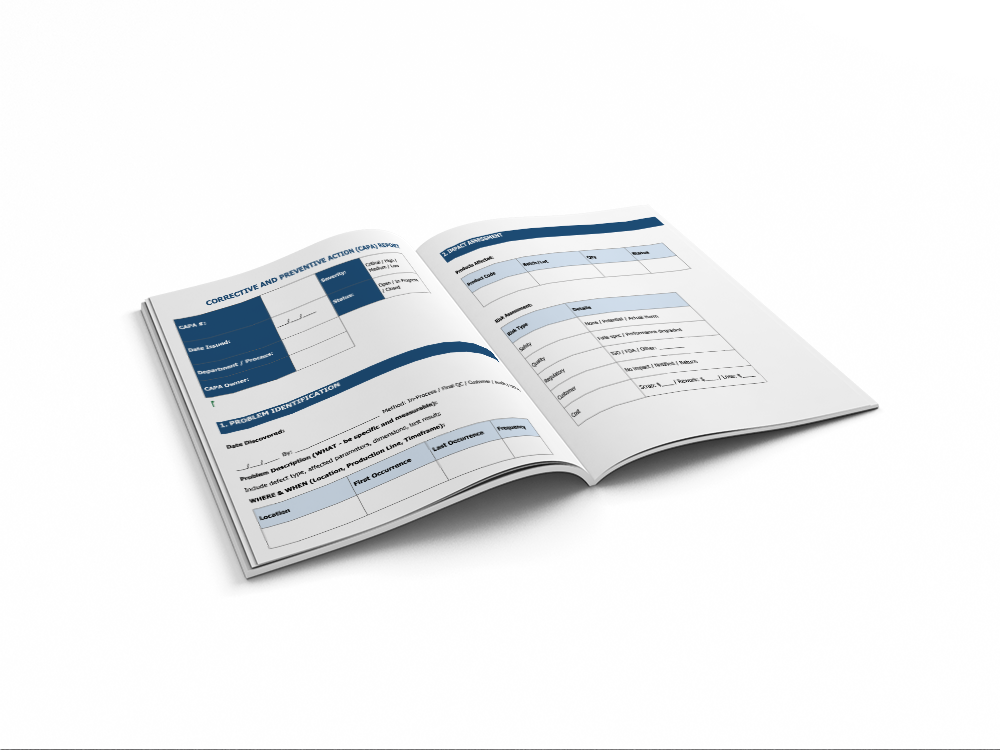
Improve Your Quality Management System with a Better CAPA Form
A Corrective and Preventive Action (CAPA) form should do more than satisfy an audit. It should help engineering, production, and quality teams investigate problems systematically, identify the real root cause, assign corrective actions, and verify that the issue doesn't happen again.
This CAPA form, in Word and PDF, is built specifically for manufacturing environments, combining structured investigations with a practical workflow that production, quality, and engineering teams can actually use.
Whether you're managing customer complaints, supplier quality issues, process deviations, non-conforming products, recurring defects, audit findings, or production failures, this free CAPA form gives your team a standardized process for documenting every investigation from issue identification through final approval.
What's Inside the Free CAPA Form Template
1. CAPA Information & Case Identification
2. Problem Identification & Non-Conformance Details
Designed specifically for manufacturing quality teams with dedicated fields for production lines, lot traceability, defect classification, equipment failures, supplier issues, and customer complaints.
Practical Root Cause Analysis
Includes a built-in 5 Whys framework, impact assessment, corrective action planning, preventive action tracking, and effectiveness verification so every investigation follows a consistent process.
Ready to Use
Download the CAPA form as a Word document or PDF, print it for shop floor investigations, or complete it digitally.
Audit & ISO Ready
Designed to support ISO 9001 quality management systems by providing a structured record of investigations, corrective actions, and approvals.
Download Your Free CAPA Form
Fill in your details and we'll email you the free CAPA form in Word and PDF — no cost, no commitment.
Thank you! Your submission has been received!
Oops! Something went wrong while submitting the form.
FAQs
A CAPA form is a standardized document used to record a Corrective and Preventive Action (CAPA) investigation. It captures the problem, root cause, corrective actions, preventive actions, verification activities, and approvals needed to ensure quality issues are resolved and do not recur. A CAPA form is commonly used in manufacturing, quality management, and ISO 9001 environments.
CAPA stands for Corrective and Preventive Action. Corrective actions eliminate the root cause of an existing nonconformance, while preventive actions reduce the likelihood of similar issues occurring in the future.
A CAPA form should be completed by documenting the problem, assessing its impact, investigating the root cause, defining corrective and preventive actions, assigning responsibilities, verifying implementation, monitoring effectiveness, and obtaining final management approval before closure.
A CAPA should be initiated whenever recurring defects, customer complaints, supplier quality issues, audit findings, production deviations, equipment failures, regulatory observations, or significant process nonconformances are identified.
A typical CAPA process includes: 1) Identify the issue, 2) Contain the problem, 3) Investigate the root cause, 4) Implement corrective actions, 5) Implement preventive actions, 6) Verify effectiveness, and 7) Close the CAPA after successful review.
A complete CAPA form should include CAPA information, problem description, impact assessment, root cause analysis, corrective actions, preventive actions, implementation tracking, effectiveness verification, and approval signatures.
The 5 Whys is a root cause analysis technique that repeatedly asks "Why?" until the underlying cause of a problem is identified. Rather than correcting symptoms, it helps teams identify and eliminate the actual source of recurring quality issues.
Approval typically involves the CAPA owner, department manager, quality manager, and, where required, plant management or regulatory representatives. Approval confirms that corrective actions have been implemented and verified before the CAPA is formally closed.
Common CAPA mistakes include treating symptoms instead of root causes, skipping containment actions, assigning vague corrective actions, failing to verify effectiveness, missing due dates, inadequate documentation, and closing CAPAs before confirming the issue has been permanently resolved.
ISO 9001 requires organizations to address nonconformities and implement corrective actions to eliminate their causes and prevent recurrence. While the latest version no longer uses the term "preventive action" as a standalone clause, CAPA remains a fundamental quality management practice for maintaining an effective QMS.
A manufacturer identifies recurring dimensional defects during final inspection. The immediate corrective action is to quarantine the affected batch and inspect all completed parts. Using the 5 Whys, the team determines that excessive tool wear caused the dimensional variation. The corrective action is to replace the worn tooling, while the preventive action is to introduce a scheduled tool replacement program and update the preventive maintenance plan. After monitoring production for 30 days with no recurring defects, the CAPA is verified and closed.
The CAPA owner is typically responsible for coordinating the investigation, but successful CAPAs are usually completed by a cross-functional team that may include quality engineers, manufacturing engineers, production supervisors, maintenance personnel, supplier quality engineers, and operations managers. Final approval is generally provided by the quality manager or designated management representative.
Corrective action removes the verified root cause of an existing problem to prevent it from happening again. Preventive action focuses on identifying potential risks and implementing improvements before similar issues occur elsewhere. Together, they form the foundation of an effective CAPA process.