Across industries, engineers and buyers rely on hex bolts because they offer predictable performance. Their strength, geometry, and standardisation make them one of the most dependable fasteners in manufacturing and construction.
While they’re simple in form, choosing the right one needs an in-depth understanding of dimensions, grades, and material behaviour.
A hex bolt is a threaded fastener with a six-sided head, designed to be tightened with a wrench or socket. They’re used where strong, reliable fastening is needed, and where torque application is higher than what screwdrivers or Allen keys allow.
Hex Bolt vs Hex Head Bolt vs Hex Cap Screw
There are different terminologies depending on the country your design standards come from:
A hex bolt and a hex head bolt are essentially the same. Hex bolts, particularly in structural or fabrication work, are often partially threaded, with the unthreaded shank designed to take shear loads. Hex cap screws are typically fully threaded and manufactured with slightly tighter dimensional tolerances.
While there are variations of hex bolts by finish, material, and size, one common distinction is the threading. Here are two main hex bolt types:
These have threads running the entire length of the shank. And it’s best to choose fully-threaded hex bolts when the bolt’s primary job is clamping, not carrying shear, and when you need to fasten thinner plates or multiple washers or nuts. Fully-threaded hex bolts are also necessary when you require adjustability, like tightening through variable stack-ups.
These have a smooth, unthreaded shank near the head, also called the grip length. This is commonly used when the joint carries shear loads, and the bolt forms part of a structural assembly. The smooth shank handles the shear forces better than threaded sections, which is why machinery frames, mounting brackets, and load-bearing joints often require partially threaded bolts.
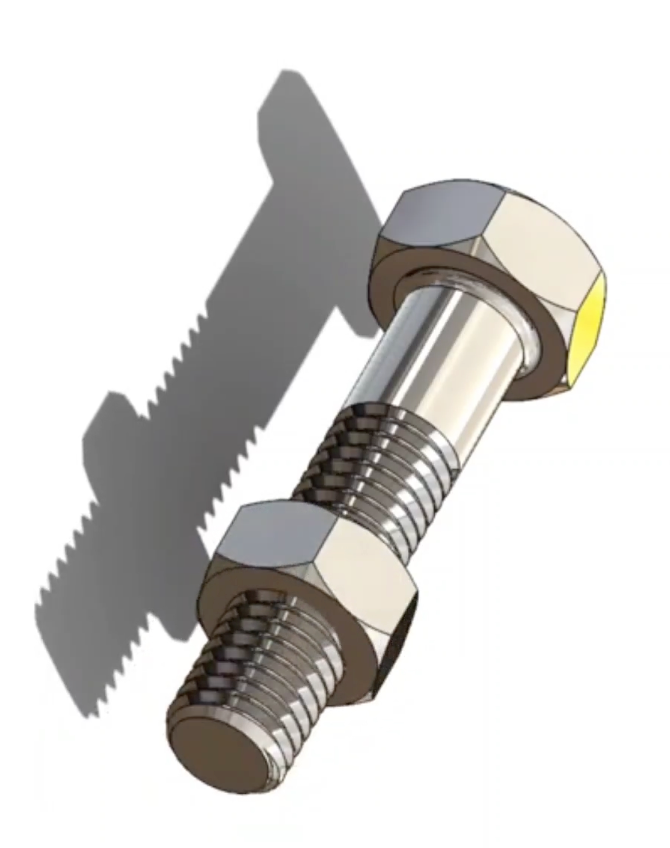
There are different dimensions needed to choose a hex bolt: the diameter, the thread pitch, the length measured from under the head, and the head size across flats. Head height dimensions are also critical, especially in sheet-metal housings, machine enclosures, and assemblies where tool access is tight.
DESIGNED AT WOOTZ.WORK
Let’s understand hex bolt dimensions with the example.
Here’s how the specification looks like for an M10 hex bolt:
While an M10 bolt typically has a 17 mm head across flats, the Japanese JIS standard specifies a smaller head. And when we move to an imperial 3/8" bolt, it’s an entirely different system with threads per inch instead of pitch.
Most teams work in mixed environments, like EU designs, US machines, and APAC vendors. So eventually, they develop their own internal cheat sheets for common sizing simply because it reduces unnecessary back-and-forth with bolt suppliers.
While a bolt’s size determines its strength, the material, grade, and coating also influence failure rate. A correctly sized bolt made from the wrong material can corrode, seize, or shear long before it reaches its rated capacity. Here are a few tips for choosing the right hex bolt materials and finishes.
Here are the common materials used for hex bolts:
While carbon steel hex bolts work for most installations, alloy steel and stainless steel hex bolts are best suited for environments exposed to harsh weather, chemicals, vibration, or heat.
Here are some of the standard finishes for hex bolts to choose from:
Choosing the right finish can affect torque, thread lubrication, and long-term maintenance. A cheap zinc coating in an outdoor application almost guarantees early rust and seized fasteners.
DESIGNED AT WOOTZ.WORK
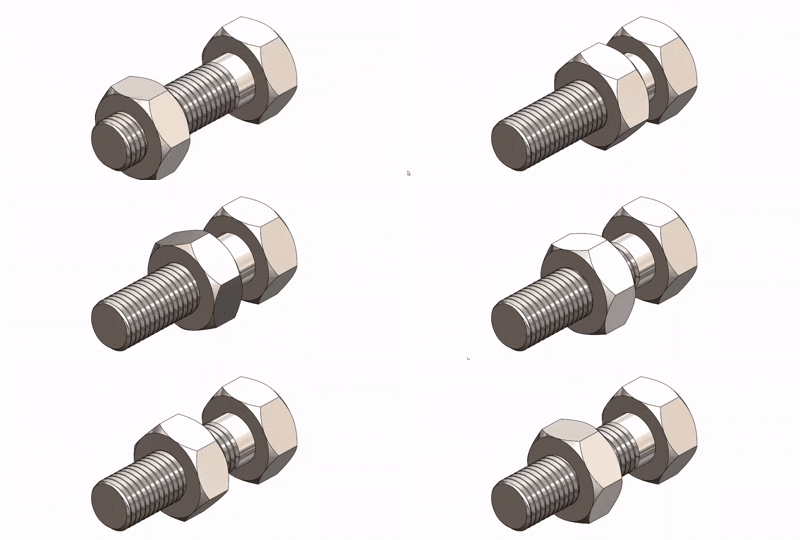
There are several factors to consider when choosing a hex bolt, and each is important for ensuring its longevity.
When maintaining or expanding a system, it's best to stick with the original bolt standard. European and most Asian machinery typically uses metric sizing, while many older American machines, especially in the oil and gas sectors, still depend on imperial bolts.
Mixing these standards can lead to serious mechanical issues under load, so it's essential to do thorough research before making a choice.
Even if a hex bolt fits perfectly, it might not be suitable if it reacts poorly with the material it's being threaded into. For instance, stainless steel can seize when used with stainless steel (called galling) or may cause galvanic corrosion if used with aluminum. Also, alloy bolts can distort threads in softer metals.
If the bolt and the housing don’t fit well, the joint won’t hold up, no matter how strong the bolt looks on paper.
Select a bolt grade that matches the forces it will be under. Higher-grade bolts, like 10.9 or 12.9, provide greater tensile strength but can act differently under shock or vibration. In contrast, lower grades (like 8.8 or Grade 5) are often better for lighter loads.
It's more about matching the grade to the load path rather than always opting for the strongest option, as this can help manage costs and prevent brittleness.
Choosing the right head type is one of the most common issues, especially when replacing legacy parts.
Coarse threads handle rough treatment and debris better, while fine threads clamp tighter but are more prone to cross-threading if alignment is off. Always try to match the original thread specifications to avoid issues during assembly or maintenance.
Choosing the right finish can make a hex bolt that lasts for years. You can choose from popular options like zinc plating, black oxide, hot-dip galvanizing, and passivation. The finish impacts its resistance to moisture, heat, or corrosive environments; some finishes also change the friction coefficient, which can affect how tightly the bolt is tightened.
The conditions where the bolt is used matter a lot when choosing the bolt material. A carbon-steel bolt placed outdoors will eventually rust, even if it looked fine during assembly. High-salt or high-humidity zones need stainless or properly coated fasteners. Chemical environments may require 316 stainless steel or specific coatings to ensure long-term performance.
Not every hex bolt can handle every load direction. Depending on how a bolt will be loaded, you may need a fully threaded bolt or one with a proper shank. Threads are weaker under shear, so if there are forces acting sideways. So opt for a bolt with a sufficient shoulder to help avoid wear and loosening.
Understanding the type of hex bolts you'll need is just the first step; effectively communicating your requirements to suppliers is equally important. Here are some key points to finalize before seeking quotes:
Before approaching a supplier, it helps to lock in the essential parameters, like:
While there are critical requirements, here are a few additional details worth finalizing for more accurate quotes:
All of these details shape the cost and even the feasibility of what you’re ordering. If you include these elements in your drawings or spec sheets, suppliers can match your requirements faster to their inventory or what they can manufacture, which reduces the uncertainty and speeds up the quoting process.
For teams juggling multiple projects, having a reference sheet with common sizes, preferred grades, and finishes can really help streamline sourcing and cut down on surprises during production.
Bulk purchasing becomes an advantage when your project pipeline consistently uses the same bolt families like M8, M10, M12, or their imperial equivalents. High-frequency sizes benefit the most because they tie directly to continuity on the assembly line. When common fasteners are readily available, teams avoid stoppages and reduce the administrative overhead of repeated small orders.
However, bulk buying is not just a cost reduction exercise. It also helps stabilize quality, because a single batch maintains uniform coatings, strength, and thread characteristics. For industries like automotive, heavy equipment, or infrastructure, consistency matters more than a minor difference in unit price.
On the other hand, project-specific bolts, like unusual lengths, non-standard coatings, or high-strength grades like 12.9, are better sourced in controlled small batches. This ensures each bolt is manufactured, tested, and packed to exact requirements, rather than pulled from generic inventory.
Standard hex bolts are usually the best fit when the design follows international norms. ISO, DIN, ASTM, and ASME sizes cover most machinery and fabrication needs, and sticking to catalog sizes simplifies procurement, lowers cost, and ensures easy replacement for years.
Custom fasteners come into play when the design requires something the catalog cannot provide, like a specific shank length for shear load applications, altered head geometry for tight clearances, a rare thread pitch, or even an alloy chosen for heat, vibration, or chemical exposure.
In such cases, a custom bolt preserves the intent of the original design without compromising the surrounding parts or assemblies.
Choosing the right hex bolt requires attention to dimensions, grade, coating, and compatibility with your existing system. When these details line up, maintenance becomes easier, and assemblies stay predictable under load. With a clear understanding of standards and sizing, most teams can avoid the common missteps that lead to premature failures or sourcing headaches.

.svg)


